Kabotie Lomawywesa Rare Hopi’Tut VIII’ Embossed Proof Print 28/100 CIMCIMCIMCI

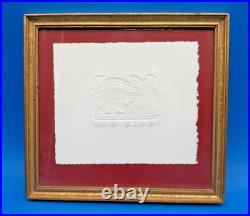
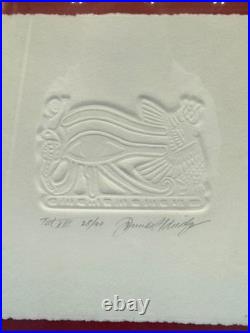
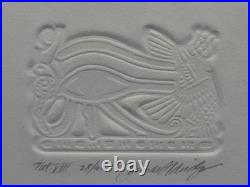


The artwork in your photos is a. Rare, limited-edition embossed (or blind-embossed / white-on-white) print. By Hopi Native American artist. Also known by his Hopi name. (meaning “Walking in Harmony”). Born in 1942 in Shongopovi (Second Mesa, Arizona) and passing in 2009, Kabotie was a multifaceted and influential Southwestern artist-renowned as a silversmith, painter, sculptor, ceramist, poet, and teacher. He came from a notable artistic lineage as the son of famed Hopi artist Fred Kabotie, and his work often drew from Hopi mythology, symbolism, petroglyphs, pottery motifs, and cultural narratives, blending traditional elements with contemporary expression. This particular piece appears to be a. Proof print or artist’s proof. (noted as “Tut VIII” or possibly “Tit VIII” / “Tud VIII”-likely a title or series designation, perhaps referencing “Tut” as a shorthand or variant in his numbering system) from a limited edition of. It is hand-signed in pencil below the image as. This is almost certainly a variant or phonetic/misread spelling of. (or a related signature style he used), as his name “Lomawywesa” is sometimes written or interpreted with similar-sounding elements in cursive signatures, and Kabotie signed works variably with his English and Hopi names. His signatures often appear in flowing script on his prints and artworks. (intaglio or relief embossing without ink/color), creating a subtle, tactile, raised white-on-white design on textured, deckle-edged handmade paper. The image is formed purely through pressure and depth, giving it a sculptural, almost bas-relief quality that catches light and shadow for a three-dimensional effect. This technique is characteristic of some of Kabotie’s more experimental or symbolic works, emphasizing form, texture, and cultural motifs over color. The embossed design features a stylized, symmetrical. Mythic or symbolic bird-like figure. (possibly a stylized eagle, parrot, or mythological avian entity from Hopi lore, common in his work). It has flowing, wave-like wings or feathers extending outward, a prominent central. (almond-shaped and detailed), and decorative elements like clusters of dots or grapes/berries along the sides. Below the figure is a horizontal band or base with repeated geometric or symbolic lettering/ patterning that reads as. Or similar (likely a stylized Hopi-inspired motif, clan symbol, or abstracted pottery design element-possibly evoking migration symbols, emergence themes, or ceremonial patterns). Compact and elegant, centered on the sheet. The embossing creates soft highlights and shadows, making the bird/eye motif appear to “float” or emerge from the paper. The paper has a soft, fibrous, handmade texture with deckled (rough, natural) edges, typical of fine art prints. Pencil-signed lower margin: “Tut VIII” (title/series), “28/100″ (edition number), and the artist’s signature. This indicates it’s from a small run, enhancing its rarity and collectibility. Matted and framed in a gold/gilt wooden frame with a deep red/maroon mat backing, overall frame dimensions approximately. 9 inches x 8.25 inches. The visible artwork area is smaller, likely around 5-7 inches wide based on the photos, fitting compactly within the frame. Kabotie’s embossed or relief prints are less common than his colorful paintings, lithographs, or silverwork, making this a. Similar embossed pieces by him e. His work frequently explores Hopi themes like emergence from worlds below, migration, nature spirits, and harmony-here, the eye and bird may symbolize vision, protection, or spiritual awakening. As a proof or low-numbered edition (28/100), it holds added value for collectors of Native American fine art. The piece is in excellent condition from the images: no visible tears, foxing, fading, or damage to the paper or embossing, with clean edges and a well-preserved signature. This is a beautiful, understated example of Hopi contemporary art-subtle yet powerful in its tactile presence and cultural depth.