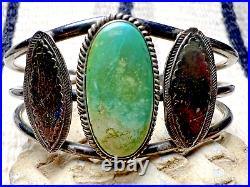
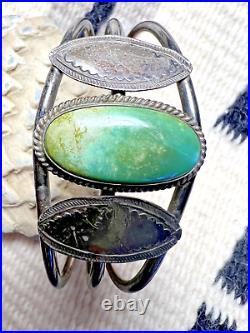
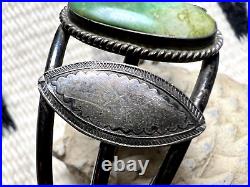
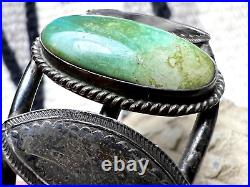
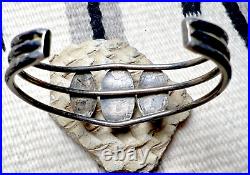
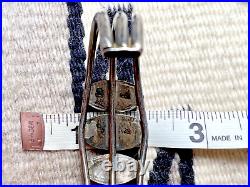
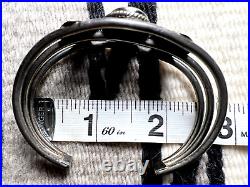
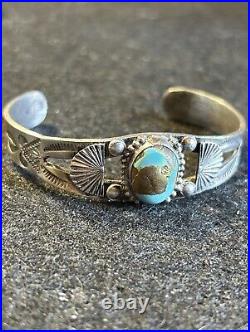
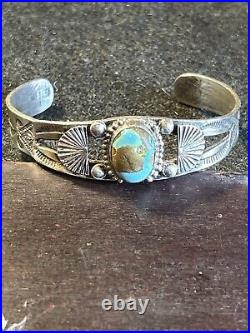
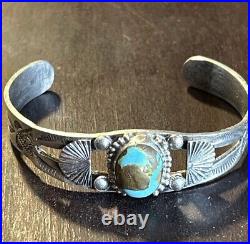
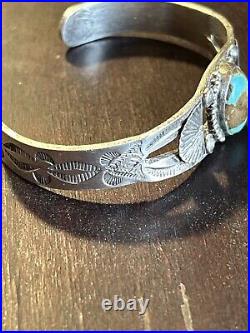
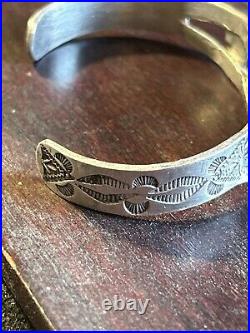
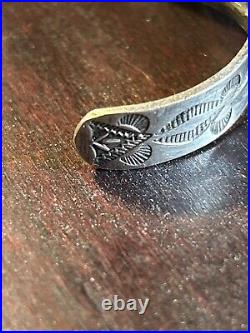
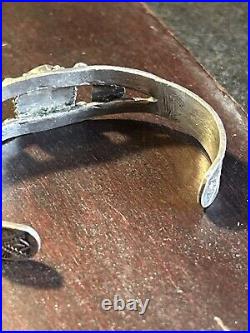
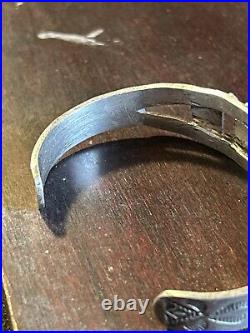
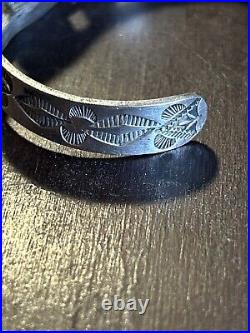
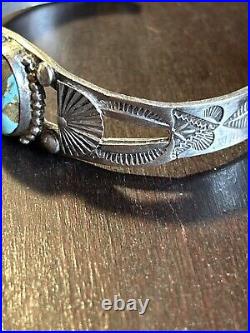
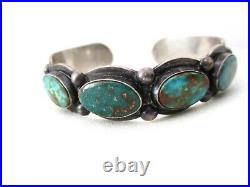
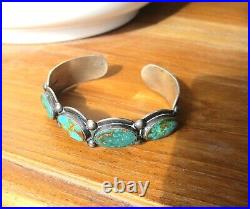
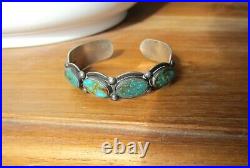
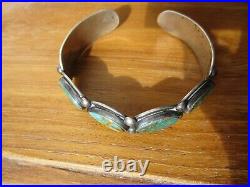
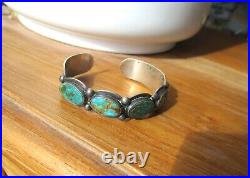
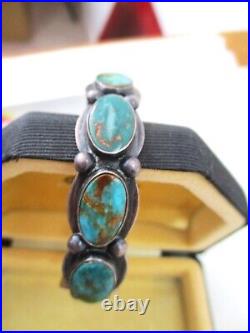
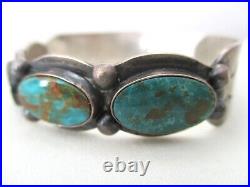
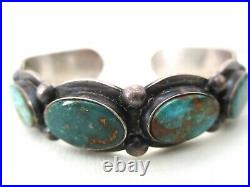
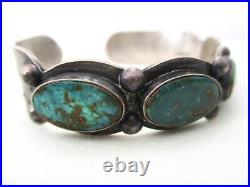
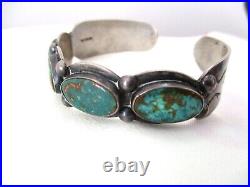
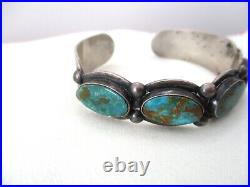
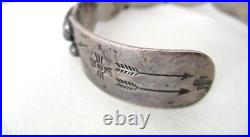
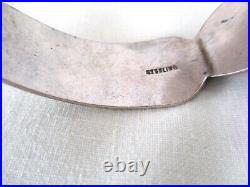
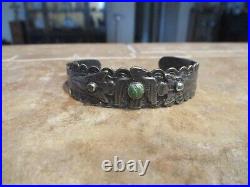
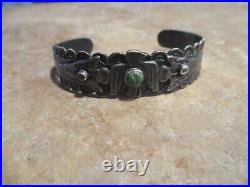
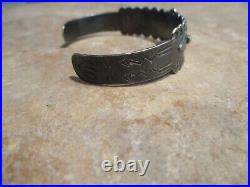
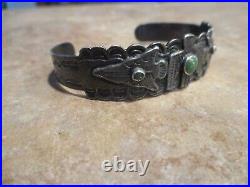
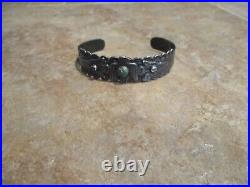
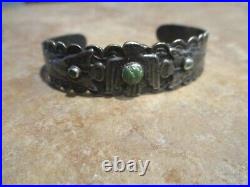
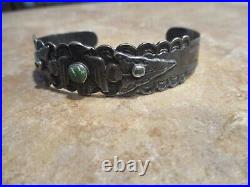
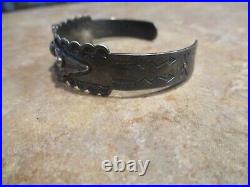
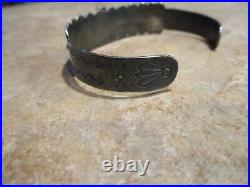
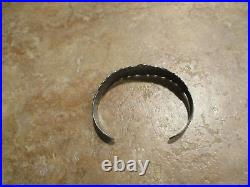
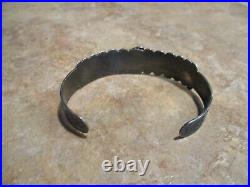
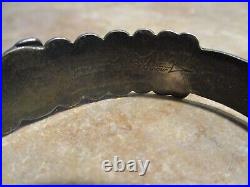
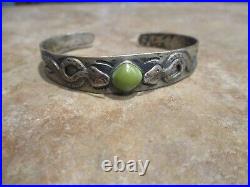
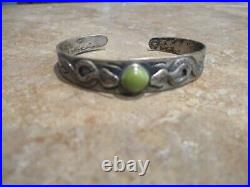
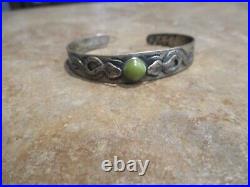
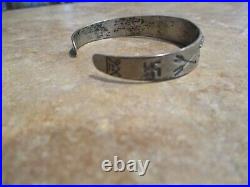
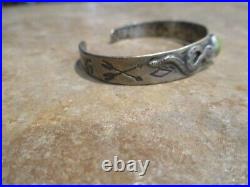
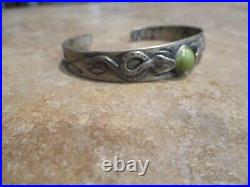
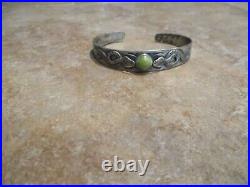
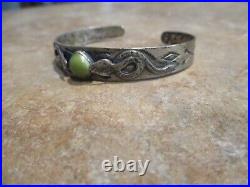
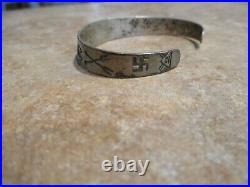
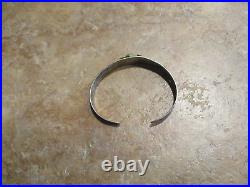
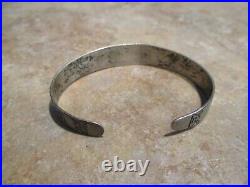
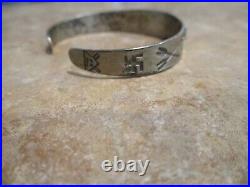
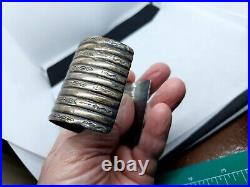
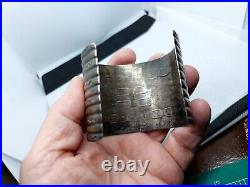
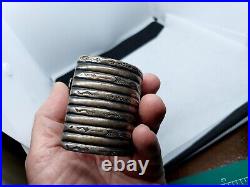
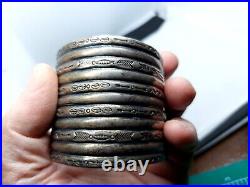
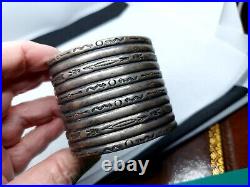
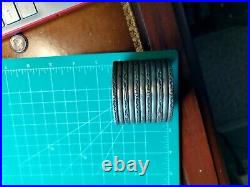
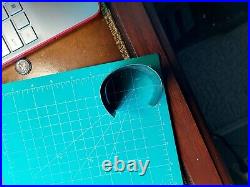
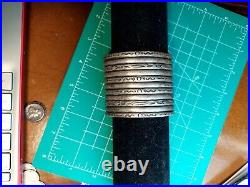
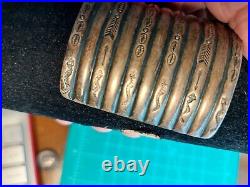
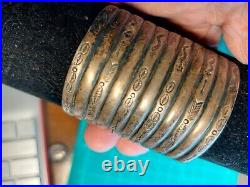
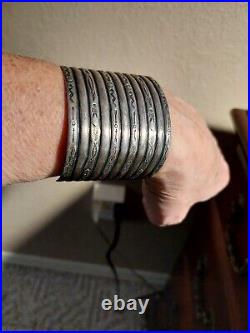
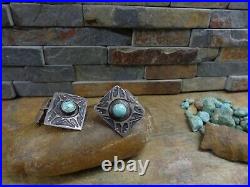
Gorgeous vintage Southwestern turquoise Fred Harvey era sterling silver cuff. Intricate hand stamping on oval sterling accents. Gap about 1 1/4 (has give). Inner circumference minus gap about 5 1/4. Thus total circumference approximately 6.5. Weighs approximately 29 grams. Check out our other gorgeous Southwestern jewelry!
This is a rare vintage Native American Navajo Fred Harvey bracelet made of sterling silver, featuring a natural oval turquoise stone in a bezel setting. It has a cuff bangle style with stackable and engraved features. Handmade with excellent cut grade, the piece is authentic to Navajo tribal affiliation and showcases ethnic and Native American themes. This unique bracelet is a collector’s item with historical significance.
From a Salida, Colorado estate of a collector of fine items from around the world and Native American Jewelry, a fine example, beautifully crafted vintage Fred Harvey Era sterling silver and green turquoise Navajo Southwest Native American Bracelet. Stamped with arrows, thunderbird, etc. She was a nurse and world traveler before settling in Salida years later. She was 106 when she passed away. She frequently traveled the Southwest and collected Native American items. The bracelet measures 5/8″ wide, 2 1/4″ across, 2″ front to back and open space to slip it on measures 11/16″. Happy to answer your questions. WE APPRECIATE YOUR FEEDBACK SO VERY MUCH AND WILL LEAVE FEEDBACK FOR YOU!!
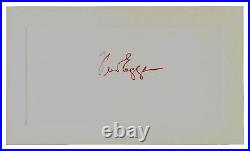
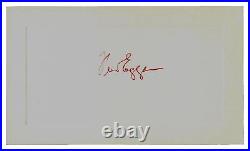
“Anthropologist” Fred Eggan Hand Signed 3X5 Card. May 7, 1991 was an American. Best known for his innovative application. Of the principles of British. The study of Native American tribes. He was the favorite student of the British. Radcliffe-Brown’s years at the. Peoples in the southwestern. Eggan later taught at Chicago himself. His students there included. His best known works include his edited volume. Anthropology of North American Tribes. Was also an anthropologist. Was a North American anthropologist in the 20th. Century and part of the anthropology department at the University of Chicago. He is a world-renowned social anthropologist, most famous for his works in the. Southwest involving the Hopi Indians and many of the social changes that take. Place within the Western Pueblos. Claims Fred Eggan is a founder of modern. American anthropoly’s eclectic approach, which combines the functionalism of. Radcliffe-Brown with the historical approach of Franz Boas. In a paper titled. “Among the Anthropologist, ” Eggan answers a question posed by Margaret Mead. Shouldn’t we all be branches of one human science? Eggan states that anthropology should center on. Man and his works, while providing a spectrum of specialized fields which. Interlock with those of the social and behavioral sciences. Born in Seattle, Washington on September 12, 1906 to Alfred Eggan and Olive. Eggan earned his master’s degree in psychology with a minor in. Anthropology from the University of Chicago in the early 20th century. He received his PhD in anthropology from the. Same university several years later with a doctoral thesis entitled Social. Organization of the Western Pueblos analyzing the social organization of. Pueblo Indians in the Southwest. Fred was an active member in the discipline of. Anthropology at a critical time when new technologies and methods were being. Invented for archeological purposes. He mentions these innovations in his paper. On Social Anthropology and the Method of Controlled Comparison. He speaks of the new aids to anthropological. Research such as radiocarbon dating, genetics, and the experimental method. Which are just a few of the many rapid technological advances that had taken. Place to aid the discipline in this time. Eggan married Dorothy Way in 1938. She was also an anthropologist of the Hopi. Fred died in his house in Santa Fe, New Mexico. From heart failure on May 7, 1991; he was 84.
“Anthropologist” Fred Eggan Hand Signed 3X5 Card. May 7, 1991 was an American. Best known for his innovative application. Of the principles of British. The study of Native American tribes. He was the favorite student of the British. Radcliffe-Brown’s years at the. Peoples in the southwestern. Eggan later taught at Chicago himself. His students there included. His best known works include his edited volume. Anthropology of North American Tribes. Was also an anthropologist. Was a North American anthropologist in the 20th. Century and part of the anthropology department at the University of Chicago. He is a world-renowned social anthropologist, most famous for his works in the. Southwest involving the Hopi Indians and many of the social changes that take. Place within the Western Pueblos. Claims Fred Eggan is a founder of modern. American anthropoly’s eclectic approach, which combines the functionalism of. Radcliffe-Brown with the historical approach of Franz Boas. In a paper titled. “Among the Anthropologist, ” Eggan answers a question posed by Margaret Mead. Shouldn’t we all be branches of one human science? Eggan states that anthropology should center on. Man and his works, while providing a spectrum of specialized fields which. Interlock with those of the social and behavioral sciences. Born in Seattle, Washington on September 12, 1906 to Alfred Eggan and Olive. Eggan earned his master’s degree in psychology with a minor in. Anthropology from the University of Chicago in the early 20th century. He received his PhD in anthropology from the. Same university several years later with a doctoral thesis entitled Social. Organization of the Western Pueblos analyzing the social organization of. Pueblo Indians in the Southwest. Fred was an active member in the discipline of. Anthropology at a critical time when new technologies and methods were being. Invented for archeological purposes. He mentions these innovations in his paper. On Social Anthropology and the Method of Controlled Comparison. He speaks of the new aids to anthropological. Research such as radiocarbon dating, genetics, and the experimental method. Which are just a few of the many rapid technological advances that had taken. Place to aid the discipline in this time. Eggan married Dorothy Way in 1938. She was also an anthropologist of the Hopi. Fred died in his house in Santa Fe, New Mexico. From heart failure on May 7, 1991; he was 84.
Inside Measures 5 1/2″ (2 1/2″ Across Inside) Plus a gap of 1 3/8. 6 7/8 Around Inside Including the Gap. Suitable for Male or Female. RARE OLD Fred Harvey Era Navajo Sterling Silver Cerrillos Turquoise Thunderbird Bracelet. 1930’s to 1940’s with Heavy Patina. The Turquoise has some crevices…. it’s as Tight as a Drum and won’t come out! This Original Bracelet can No Longer be Replaced…. Classic Navajo Craftsmanship and Design Work…. Wearable / Collectible NATIVE AMERICAN ART. Signed “Silver Arrow Sterling” with Long Arrow Symbol. Very Good Vintage Condition. Your Satisfaction is Assured. THANKS to YOU, we now Support the Navajo Water Project.
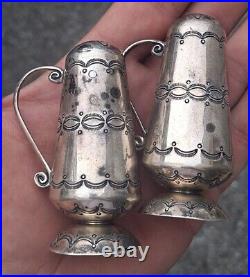
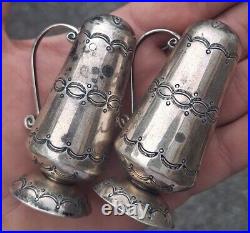
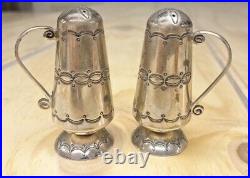
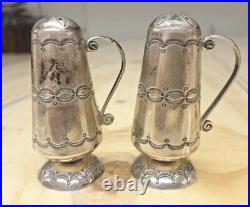
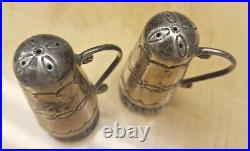
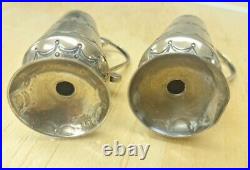
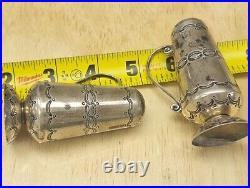
This Native American antique serving piece set is a rare find from the Fred Harvey era. Crafted by Navajo artisans, this sterling silver salt and pepper shaker set weighs 99.8g and features exquisite handmade details. The retro style with old pawn design is perfect for collectors and vintage enthusiasts. The shakers are made of 925 sterling silver with a beautiful silver base metal. These unisex adult serving pieces are perfect for any occasion and will add a touch of originality to your dining experience. The tribal affiliation and brand of the set are Native American, making it a unique addition to your collection.
Inside Measures 5 1/2″ (2 1/3″ Across Inside) Plus a gap of 7/8. 6 3/8 Around Inside Including the Gap…. RARE Old Fred Harvey Era Navajo Sterling Turquoise Whirling Log Snake Bracelet. 1930’s to 1940’s…. Excellent Quality Craftsmanship & Design. Your Satisfaction is Assured. THANKS to YOU, we now Support the Navajo Water Project. This item is in the category “Jewelry & Watches\Ethnic, Regional & Tribal\Bracelets & Charms”. The seller is “old-native” and is located in this country: US. This item can be shipped worldwide.
Rare Fred Harvey Era Stamped Bracelet 2 Inches Wide! It is unsigned and unbranded. It has fantastic stamping. It weighs 59.5 grams. It has a gap of 1 5/8. The inside diameter front to back is 1 3/4″ and the inside diameter side to side is 2 3/8″ The inside circumference without the gap is 5 5/16. Outside circumference without gap is 5 3/4. This item is in the category “Jewelry & Watches\Ethnic, Regional & Tribal\Bracelets & Charms”. The seller is “pintsize55″ and is located in this country: US. This item can be shipped to United States.
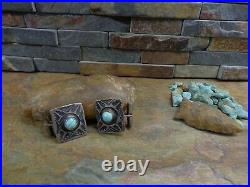
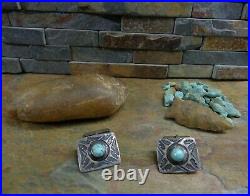
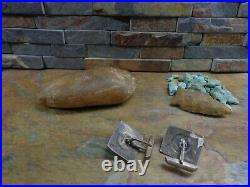
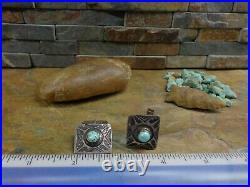
WELCOME TO OUR NATIVE “OLD PAWN” JEWELRY SALE! We are currently listing a BUNCH of GREAT NATIVE “OLD PAWN” CUFFS, RINGS, NECKLACES, EARRINGS, CROSSES and VERY UNIQUE ITEMS with AMAZING LOW PRICES EACH AND EVERY DAY! We Sincerely Hope that they become Family Heirlooms! We are HUMBLED by your TREMENDOUS SUPPORT and look forward to another great year of bringing you the best in NATIVE “OLD PAWN” & MORE!! I immediately knew what I’ve heard others talking about over the years. I felt a Great Overwhelming Pride of the Spirit of the Navajo Indian who crafted the special piece many years ago. That one day, not long ago, I got the bug. The understanding of what I’ve heard from others over the years, but until that day had not experienced. This was a special gift from a Proud and Humble Indian Artist who was doing this to feed his family. I truly hope one day that everyone can experience that magic for yourself. This listing is for A SUPERB PAIR OF EARLY NAVAJO “OLD PAWN” STERLING TURQUOISE CUFFLINKS. THESE FRED HARVEY ERA CUFF LINKS FEATURE BEAUTIFUL BLUE/GREEN HUE HI GRADE TURQUOISE GEMS EACH WITH A PHENOMENAL OLD MATRIX SET INTO CLASSIC NATIVE BEZEL SETTINGS. THESE TURQUOISE CABOCHONS ARE STUNNING ON THIS HI END SET. EACH LINK HAS FINE NAVAJO HAND STAMPED DETAILS WITHTHE EARLY HAND MADE STAMPS SURROUNDING THE GEMS AND HAVE THAT OLD DEEP WARM PATINA THAT WE ALL LOVE. THESE ARE TRULY A VERY SPECIAL AND UNIQUE PAIR. THIS IS A EARLY RARE SET OF NAVAJO CUFFLINKS WHICH ARE ALWAYS A SPECIAL FIND AND WILL SURELY BE A HIGHLIGHT IN YOUR NATIVE ATTIRE. DON’T MISS OUT ON THESE GREAT OLD CUFFLINKS DURING OUR NATIVE “OLD PAWN” JEWELRY SALE PRICES! We hear from you and understand that you have finally found the piece that you have been searching for sometimes many years but maybe just can’t finance it for a bit. We Are HONORED to help you get that Special Heirloom that you have been dreaming about. Fine Piece of Native American Artistry. Is part of what we call our. Treasures are getting harder to find as each year goes by. If one day you decide you’d like to trade it for another piece, we will happily give you full credit towards another piece from our. It’s that simple. We stand behind what we sell. We only ask that you return it in the same condition. In Addition to the the Skilled Craftsmanship that the Native Americans possessed, they also went to great work to use stones that have special natural powers. Was mined in several states in the Southwest and is a stone of Strength. It purifies the body and dispels negative energy. It is also known to aid in the absorption of nutrients, enhances the immune system and for detoxification of the body. Is another favorite of the Native American. They would trade for this beautiful stone as it’s not indigenous to their lands and is a stone of Diplomacy. It brings Inner Peace helps to Accelerate the Transfer of Knowledge. It’s easy to see why they chose these stones for their stunning jewelry! Many of our pieces include beautiful Spiderweb Turquoise and the deep stunning Red Coral that is only found in the early pieces. It is hard to guarantee the exact mine each stone came from but we do our best to honestly “guesstimate” the region from our current knowledge and the dealers/estates etc. If you like this great piece, Please view our other listings for more great finds that I’m sure you’ll enjoy. We’ll try to find something for everyone! Last but not least, Alcoholism is the number one health problem in the Native Community and I know from personal experience that 12 Step Programs can help individuals suffering from this deadly disease. These funds may be sent to a 12 Step Program affiliated with Native Americans to be used for various needs like literature or conventions. To more locally, helping a local Navajo homeless who is still suffering. Every little bit can help and this is a small way to help the descendants of these Native Americans from the past who gave us these fine pieces to enjoy! This item is in the category “Jewelry & Watches\Ethnic, Regional & Tribal\Necklaces & Pendants”. The seller is “native_old_pawn_and_more” and is located in this country: US. This item can be shipped to United States, Canada, United Kingdom, Denmark, Romania, Slovakia, Bulgaria, Czech Republic, Finland, Hungary, Latvia, Lithuania, Malta, Estonia, Australia, Greece, Portugal, Cyprus, Slovenia, Japan, China, Sweden, South Korea, Indonesia, Taiwan, South Africa, Belgium, France, Hong Kong, Ireland, Netherlands, Poland, Spain, Italy, Germany, Austria, Bahamas, Israel, Mexico, New Zealand, Philippines, Singapore, Norway, Saudi Arabia, United Arab Emirates, Qatar, Kuwait, Bahrain, Republic of Croatia, Malaysia, Chile, Colombia, Costa Rica, Panama, Trinidad and Tobago, Guatemala, Honduras, Jamaica, Antigua and Barbuda, Aruba, Belize, Dominica, Grenada, Saint Kitts-Nevis, Saint Lucia, Montserrat, Turks and Caicos Islands, Barbados, Bangladesh, Bermuda, Brunei Darussalam, Bolivia, Egypt, French Guiana, Guernsey, Gibraltar, Guadeloupe, Iceland, Jersey, Jordan, Cambodia, Cayman Islands, Liechtenstein, Sri Lanka, Luxembourg, Monaco, Macau, Martinique, Maldives, Nicaragua, Oman, Pakistan, Paraguay, Reunion.